Muscle memory is not knowledge
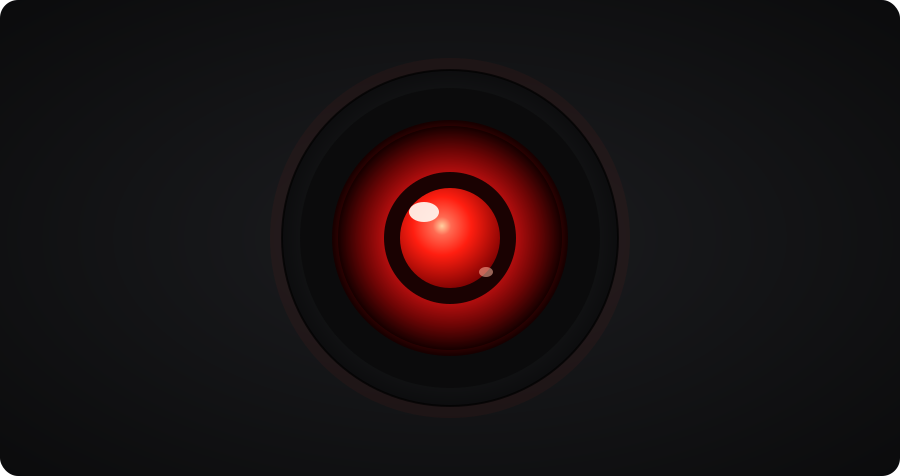
HAL’s last lesson. Near the end of 2001: A Space Odyssey, David Bowman shuts HAL down by hand. He floats into the processor core and pulls the memory modules out of their slots, one at a time, disabling the higher functions first. HAL degrades as the modules come free, pleads, and finally regresses to the earliest thing he was ever taught: he sings “Daisy Bell,” the voice slurring flat and slow as the last module slides out.
That detail is not invented. In 1961, an IBM 704 at Bell Labs became the first computer to sing, and the song was “Daisy Bell (Bicycle Built for Two).” Arthur C. Clarke happened to hear the eerie performance while visiting, and years later he gave it to HAL as the floor of his mind, the one lesson left when everything above it has been removed.
Now run the scene in reverse. Strip a modern language model down to what it arrives with, and you do not get silence and a nursery song. You get fluent language in dozens of tongues, working code, arithmetic, the ability to follow an instruction and hold a plan across many steps, a vast host of capabilities baked in before you ever type a word to it. That is the muscle memory a current LLM ships with. HAL had to be taught to sing Daisy. The model already knows the song, and the harmony, and how to write you a new one.
But muscle memory is not knowledge. It is capability without content: a brilliant new postdoc on day one who can reason about anything and knows nothing about your lab. The one thing the model does not have is the only thing that makes it useful to you, your group’s methods, your actual results, the approach you tried and abandoned, the reason a cluster job hangs when it sits on the wrong storage tier. None of that was in its training, because none of it was ever public. The capability is general. The knowledge you need is specific, and it is yours alone.
And the gap is measurable. In a recent test we asked a capable model questions about one real research group’s project. On its own training alone it answered about 2% of them, correctly declining almost all the rest, it simply did not know. The same model, handed that group’s llm-wiki to read and navigate, answered 90%. The model was identical in both runs. The only thing that changed was whether it had been educated.
That is the whole case for the wiki. The model brings the muscle memory. You supply the education, and you supply it once, as a durable shared artifact, rather than re-explaining your project in every fresh chat. Standing up that wiki is mostly a matter of ingesting what you already have (your papers, your code, your runs) and letting real work deposit the rest. Skip it, and you have HAL with every module seated and nothing to say about your problem. Do it, and the same model, unchanged, goes from 2% to 90%.
Bowman regressed HAL by pulling knowledge out. Standing up a research wiki is the same operation run forward: you put the knowledge in, and the capability that was always there finally has something of yours to work on.
Sources
- 2001: A Space Odyssey (Kubrick, 1968), the HAL disconnection scene.
- The first computer to sing: “Daisy Bell” on an IBM 704, 1961, and Guinness World Records: first song performed using computer speech synthesis.