Knowledge bundles
The general idea: package knowledge for reuse. A knowledge base has historically been trapped in a tool, a proprietary format, a specific RAG index, one vendor’s platform. The move a knowledge bundle makes is to package curated knowledge so that any LLM or agent can consume it, with no SDK and no lock-in. This is a real industry direction, not a local coinage. In June 2026, Google Cloud published the Open Knowledge Format (OKF), a vendor-neutral open specification that represents knowledge as a directory of markdown files with YAML front matter (one required field, type), explicitly so that knowledge written by one producer can be read by a different agent. It is positioned as a portable alternative to RAG for “AI memory.” In practice an OKF bundle is just a directory of markdown you could open in any editor:
knowledge-engineering-bundle/
├── index.md               # a catalog of the pages
├── ontologies.md          # each page: YAML front matter + prose
└── expert-systems.md
The relationship is worth stating carefully: OKF is the general standard, and the llm-wiki pattern this project uses is one instance that conforms to it, not the other way around.
What a bundle is here. A bundle is a wiki authored with the intent that other people consume it through their own LLMs. Bundles are wikis, but not every wiki is a bundle; the distinguishing property is intent to share and be queried by non-authors. The point is that a bundle ships compiled competence, not just searchable content: a student opens a query session against a bundle on knowledge engineering and gets the group’s accumulated judgment, not a reading list. Bundles come in two shapes: a reference bundle uses a neutral retrieve-synthesize-cite protocol; a pedagogical bundle ships a Socratic or worked-example protocol embedded in its own content, so the teaching travels with the material.
Because a bundle is just a git repo of markdown plus its graph, it is portable, and OKF import and export is on the roadmap so bundles interoperate with the wider open-knowledge world rather than living in a walled garden. Your memory is yours, and it moves.
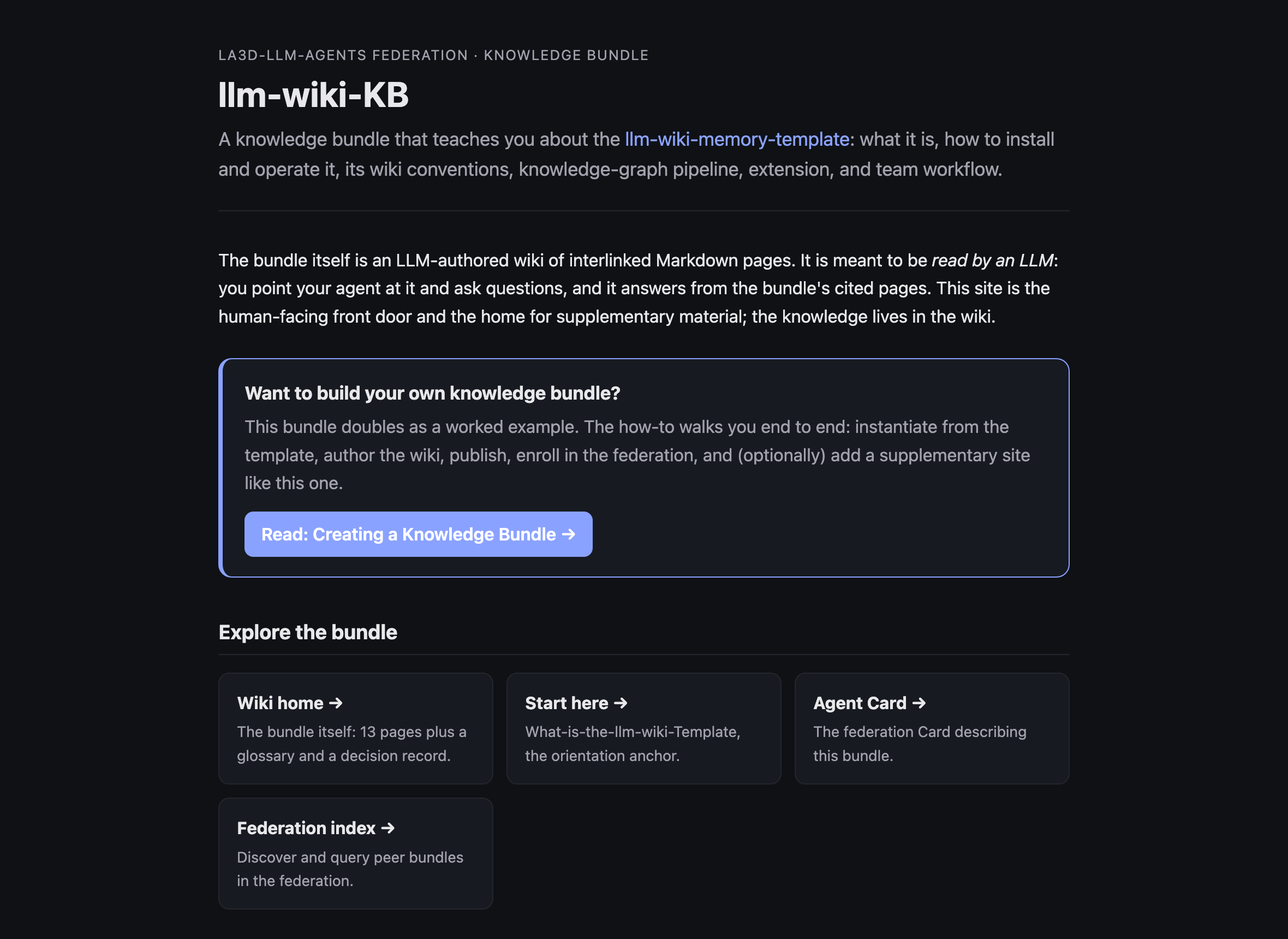
A real example: llm-wiki-KB. Our own reference bundle, llm-wiki-KB, takes the template itself as its topic. It is an LLM-authored wiki you point an agent at and ask; the page below is its human-facing front door and the home for supplementary material, while the knowledge lives in the wiki behind it.
Sources
- Google Cloud: the Open Knowledge Format, the OKF spec announcement (June 2026).
- Google Cloud announces the Open Knowledge Format (Search Engine Journal), independent coverage.