Data fabrics
What a data fabric actually is. A data fabric is a design for data management, not a product: an integrated layer (the “fabric”) that sits over an organization’s scattered, heterogeneous data sources and makes them usable together. Gartner’s framing is that it uses metadata to automate the integration work teams otherwise do by hand. The defining move is that it connects data where it lives rather than copying everything into one store: centralized in access, but not necessarily consolidated in storage.
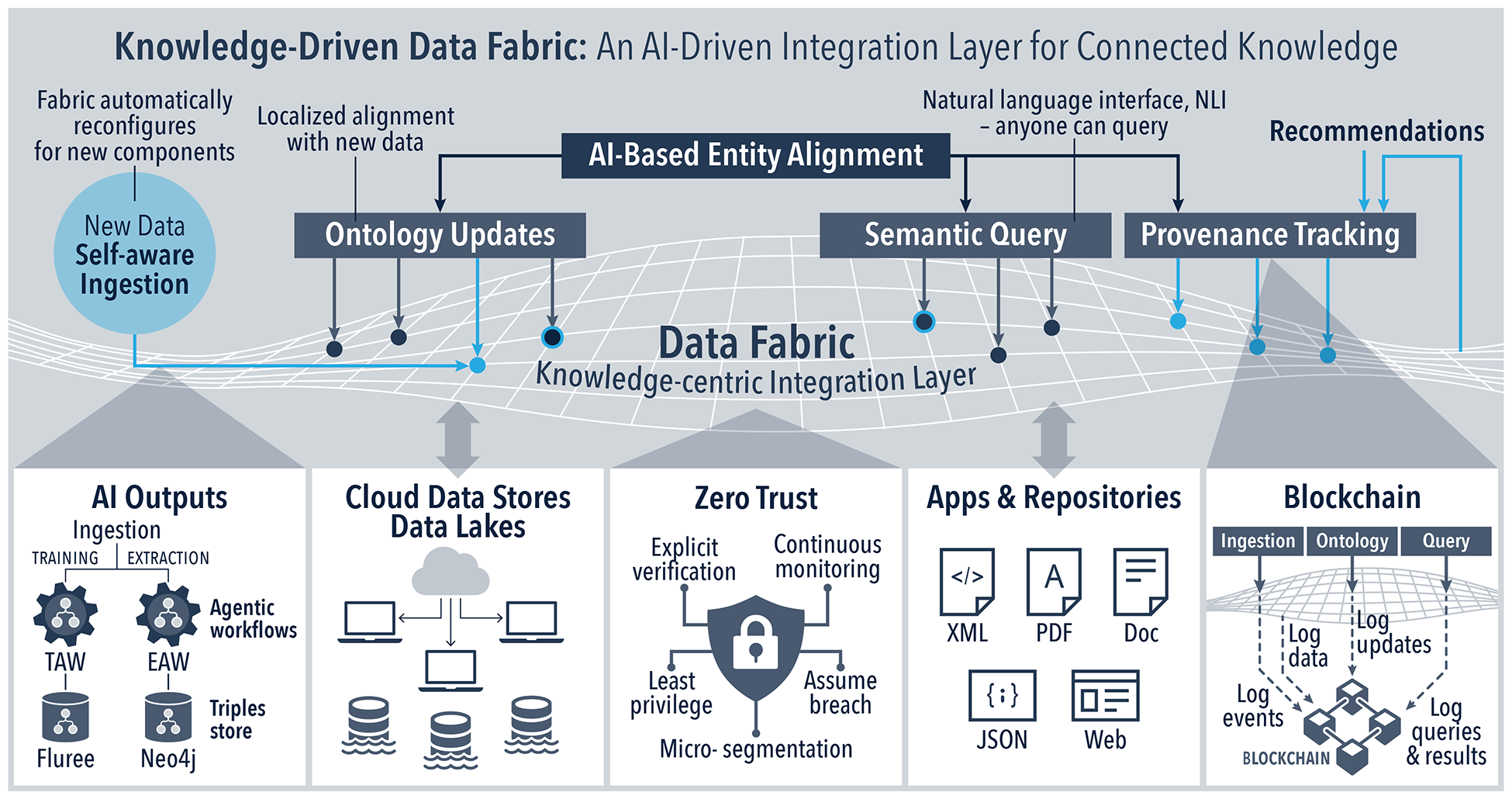
Three ingredients make that work. Active metadata: not just static schemas and glossaries (that is passive metadata) but continuous signals about how data is actually used, which the fabric analyzes to suggest and automate connections. A knowledge graph and ontology: the semantic layer that links raw sources to shared concepts, so a query can span systems by meaning instead of by hand-wired joins. And AI: to discover assets, infer relationships, and keep the integration current as sources change.
That is what separates a fabric from the things it gets confused with. A data lake or warehouse consolidates: move all the data into one big store first. A portal wires one bespoke integration per source. A fabric does neither; it leaves data in place and unifies it through the metadata and semantic layer. (A data mesh, for contrast, is a governance stance, distributed domain ownership, and can be built on fabric technology.)
Why a wiki-grounded agent belongs on this picture. The pieces a fabric is built from are pieces we already have. The wiki’s knowledge graph and small ontologies are a semantic layer. The typed edges are active metadata. Connectors are the automated integration. So a group’s outputs come out as standards-based RDF, ready to plug into a wider institutional fabric, and FAIR by construction (Findable, Accessible, Interoperable, Reusable, the data-management principles funders increasingly require) on three of those four axes. The fabric is the how of connecting data at scale; the wiki-grounded agent is how an individual researcher participates in one, and keeps the judgment and provenance a fabric alone does not carry. (The picture we mean.)
Sources
- Gartner: What is data fabric, the definition and active-metadata framing.
- Data mesh vs data fabric (Alation), the contrast with mesh.